
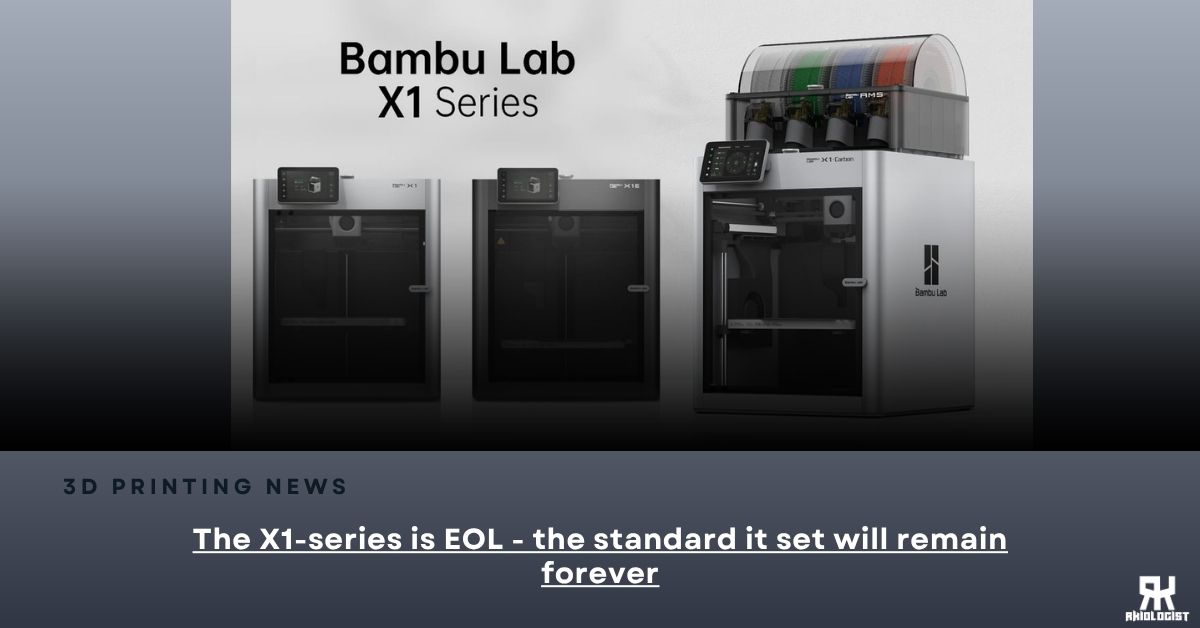
So, it finally happened. The legendary Bambu Lab X1, X1 Carbon, and X1E have officially reached end-of-life. As of March 31, 2026, these game-changing 3D printers are no longer in production. No more manufacturing, no more active sales, but before you panic, this isn’t a sudden goodbye. Bambu Lab is keeping support alive where it matters.
Users can expect continued spare parts availability and service support all the way until March 31, 2031, giving the X-series a lifecycle that’s pushing close to a full decade, something rarely seen in consumer 3D printing.
Key Dates to Remember
- End of manufacturing & sales: March 31, 2026
- Bug fixes & feature updates: Until May 31, 2027
- Security updates: Until May 31, 2029
- Spare parts & support: Until March 31, 2031
Even now, some authorized distributors may still have remaining stock, so if you’ve been eyeing a brand-new unit, this might be your last window.
The Kickstarter That Changed Everything
Back in May 2022, Bambu Lab was just another unknown name launching on Kickstarter.
But what they promised sounded almost unrealistic at the time
20,000 mm/s² acceleration, 500 mm/s speeds, built-in camera, AI-powered features, automatic calibration, and a multi-color system, all at a price that didn’t make sense for what it offered.
Most people didn’t buy into the hype. Until Bambu Lab actually delivered.
The campaign raised over $7 million from more than 5,500 backers, becoming one of the most successful 3D printing Kickstarters ever, but more importantly, it marked the start of a shift the industry couldn’t ignore.
Before X1, 3D Printing Wasn’t This Easy
If you’ve been around the scene pre-2022, you already know how things were.
3D printing wasn’t exactly “plug and play.” It was calibration-heavy, time-consuming, and honestly frustrating at times.
- First layers were hit-or-miss
- Bed-slingers dominated the market
- Speed meant sacrificing quality
- Multi-color printing was more of a weekend experiment than a feature
- Enclosures were mostly reserved for expensive, prosumer machines
Then Bambu Lab came in and bundled all of that into one ecosystem and priced it aggressively enough to shake the entire market.
How the X1 Series Reset the Standard
The X1 and X1 Carbon didn’t just compete, they forced everyone else to catch up.
Fast forward to today, and you’ll notice:
- CoreXY is now the standard
- Enclosures are expected, not optional
- Auto-calibration evolved into real-time compensation
- Extruder designs started looking very familiar
And then there’s the AMS (Automatic Material System), arguably one of the biggest shifts in consumer multi-color printing. What used to be complicated and time-consuming became accessible and reliable. But hardware was only half the story.
Bambu Lab built a full ecosystem:
- Bambu Studio made slicing more intuitive
- Bambu Handy enabled remote monitoring and control
- Built-in sensors and AI improved print reliability in real time
This wasn’t just a printer launch, it was a complete user experience overhaul.
End of an Era, Not the End of the Story
The retirement of the X1 series marks the end of a major chapter, but not the influence it leaves behind.
These machines didn’t just raise the bar, they rewrote it.
And even in retirement, they’re still doing what they’ve always done
printing, performing, and setting the standard for what a consumer 3D printer should be.


Leave a Reply