
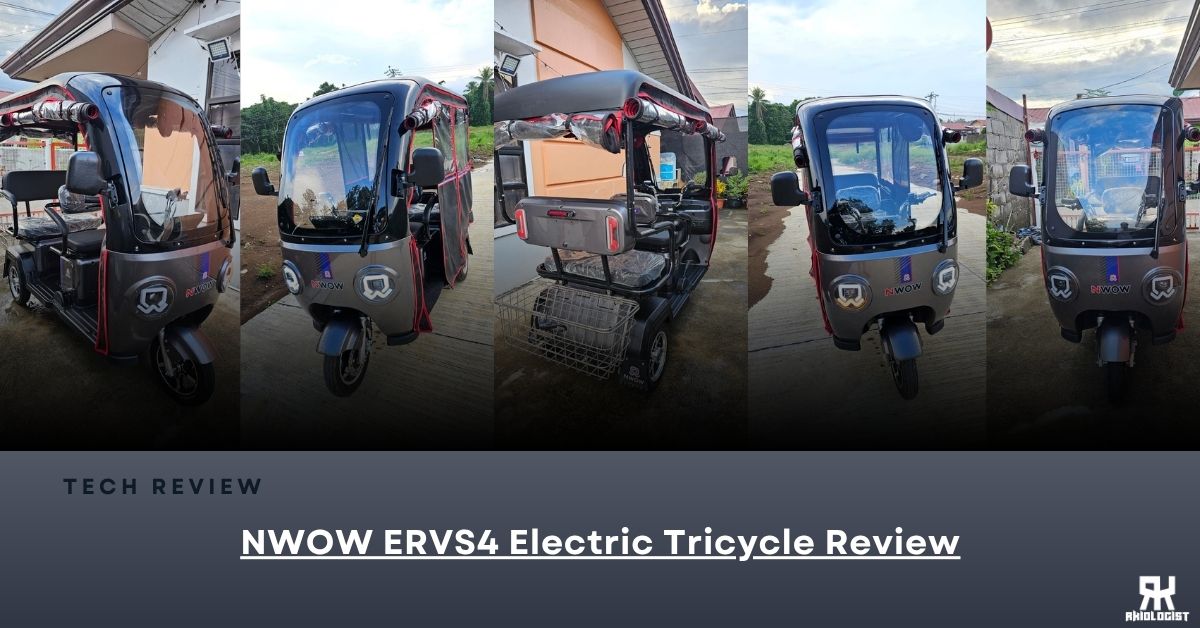
This is the first time I’m reviewing a product that is designed for everyday commuting, so this one differs a little from my usual tech reviews. With the economy the way it is, and fuel prices rising steadily, more and more people are starting to see electric vehicles as a viable way to cut down on costs.
In this review, we’ll be taking a closer look at NWOW’s ERVS4 Electric Tricycle to see if it is a really good option for your daily commute.
Specifications:
| Dimensions | 2250 x 850 x 1710 mm |
| Overall Vehicle Load Capacity | 250 kg |
| Overall Vehicle Mass | 153 kg (excluding battery) |
| Wheelbase | 700 mm |
| Speed | 32 km/h |
| Cruising Range | 52.4 km (fully loaded) |
| Braking (Front / Rear) | Front and Rear Disc Brake |
| Tyre (Front / Rear) | 3.0 – 10 |
| Climbing Ability | ≤12° |
| Braking Distance | ≤7.5 meters |
| Battery Type | LEAD-ACID |
| Capacity | 60V32AH |
| Motor Type | Central |
| Motor Power | 60V30H800W |
| Motor Voltage | 800W |
| Controller | Permanent – magnet controller 60V12T28A |
Closer Look


The NWOW ERVS4 is an electric tricycle with a three-seat configuration, one for the driver and two for passengers. It comes in three color schemes: gray, red, and white.

At first glance you will think, “Oh, it’s just a smaller Umbak or Bao-bao,” which are very common in the inner roads of every barangay or sometimes national highways.
But instead of a normal gas-powered tricycle, it is an electric-powered one that is quite slower than normal gas-powered tricycle speeds. To be exact, it can reach a maximum of 32 km/h.

At the back of the ERVS4 is a small camera, which will let you see back when you are trying to reverse your electric tricycle. This feature is one of the upgrades from its predecessors. You can see it through a display on the speedometer.

Also, there is a metal basket which can carry up to 25kg of any baggage. This is perfect for those users who always go to the market to buy goods.

Like a normal tricycle, it has headlights (high beam and low beam), turn lights that can help you navigate through the night and also make you visible to other drivers.

Also, the ERVS4 has taillights and turn lights.

The seats inside are comfortable and can accommodate a maximum of three people. Though it can fit four people (two at the front and back), it is not suggested, as the heavier the load, the more the battery will deplete fast.
Underneath the driver’s seat, there is a small compartment for things you need to keep away during travel.


The driver side of the ERVS4 is like a typical motorcycle configuration with the addition of car-like features like the windshield wiper, sprinkler, radio with Bluetooth, and a compartment area to put your things, which adds a layer of practicality.

Due to the tropical weather of the Philippines, I guess this is a good addition too, a fan to provide some relief from the heat. Making daily commute a little bit better.

The dashboard for the ERVS4 is digitalized. Here you can see the battery level, the speed, the gear (up to three levels and reverse), and also the camera view of your back camera (for reverse). Like a normal car, it will also indicate some warnings that may help you troubleshoot when there is a problem.


All of the wheels for the ERVS4 are using disc brakes which is better than using drum brakes as it is easy to maintain and expect if there are problems. Also, it has more superior stopping power.

The batteries are located in the passenger’s seat. These are lead-acid batteries.
User Experience

The image above tells you how I tested the NWOW ERVS4. This is one of the farthest distances we traveled (my wife and 4-year-old daughter) to visit my mother-in-law. This is the safest route for us to travel and where e-tricycles are allowed to pass through, which has a total distance of 16.4 km.
At first, we tried (with my wife) to travel at night the day we got the ERVS4. Going to the location, it was smooth and easy because it was mostly downhill. But when I tried to go back to our house alone, it was a struggle. In the middle of the drive, I found out that my speed was slowing even in an area without an uphill, so it got me worried.
Suddenly, when I reached the area with an uphill, my speed went down to 10 km/hr, and my battery reached two bars at 56 V, and what’s worse, it went to 5 km/hr, which is slower than my walking pace.
After that experience, I was worried and don’t want to travel that long again. But I suspected that my battery had a defect. So, I requested the NWOW branch where we got the unit to check, and after a few days, they replaced the battery as they found defects on the battery.
After it was replaced, we tested the battery again. Now, I was satisfied with the distance it can reach, as when it is fully charged, we can go back and forth to the residence of my mother-in-law without charging the unit again.
Conclusion

The NWOW ERVS4 Electric Tricycle is one of those products that makes a lot of sense depending on your situation. If you’re living in a subdivision or an area where getting to public transport requires a short ride, this can actually be a practical investment, especially now that fuel prices aren’t exactly friendly. A full charge only costs around ₱13 to ₱20 (depending on your area) already makes a strong case, considering that’s even cheaper than a single commute in some areas.
From a usability standpoint, it’s easy to drive. It feels smooth and manageable even for beginners, but it does come with a bit of a right kind of care when it comes to handling. Sudden turns can throw off the balance, especially on uneven roads where the rear wheels don’t sit at the same height, so it’s something you need to be mindful of while driving.
Performance-wise, it’s clearly not built for speed, and that’s fine. With a maximum of around 32 km/h, mostly achievable on downhill. Also, I noticed when you deplete a single bar of the battery it tends to slow down up to 2-3km/h from its maximum speed per gear. Though this is really built for picking up your family and driving them to the destination safely.
When it comes to range, NWOW claims around 52 to 67.5 km depending on load, but based on actual use, that number leans more toward ideal conditions. In real-world scenarios, especially with uphill routes and passengers, expect something closer to around 45 to 47 km per full charge. It’s something you need to factor in depending on your terrain.

Where things get a bit problematic is with the charging experience. NWOW provides a charger that indicates a full charge via a green light, but at the same time, they also recommend following a charging chart to preserve battery health. For first-time users, that can be confusing. Do you follow the charger or the chart? On top of that, charging takes quite a while, especially with the lead-acid battery setup. You’re looking at around 7.5 hours or more depending on your battery level, and you’re also advised not to let it drop below 30%, which adds another layer of management for the user.
Honestly, this is where I feel NWOW could improve. A shift to LiFePO4 batteries would’ve made a big difference, not just in charging speed but also in overall longevity and user convenience.
Another thing worth pointing out is the after-sales experience, at least based on my situation. If you end up with a defective battery, don’t expect a temporary replacement to be offered right away. You actually have to insist before they provide one, even for a brand-new unit. It’s not a deal-breaker, but it’s something potential buyers should be aware of since it affects overall ownership experience.
Overall, the ERVS4 isn’t perfect, but it knows exactly what it wants to be. It’s a practical mobility solution for short to mid distance travel, especially for families or individuals who need a reliable way to get in and out of areas where gas powered vehicles aren’t practical. As long as you understand its limitations and are willing to work around its charging quirks, it does its job, and in today’s economy, that already counts for a lot.
By the time of writing this review article, you can buy the NWOW ERVS4 for $1,087.00 or P66,800.00 at your nearest CORSAIR affiliated online and physical stores.
With this, NWOW ERVS4 receives the Recommended Award.

PROS:
- Very low running cost
- Family-oriented use case
- Decent real-world range
- No fuel dependency
- Practical for short to mid distance travel
CONS:
- Stability concerns on uneven roads
- Long charging time
- Lead-acid battery limitations
- Speed drops as battery drains
- After-sales support concern


Leave a Reply