
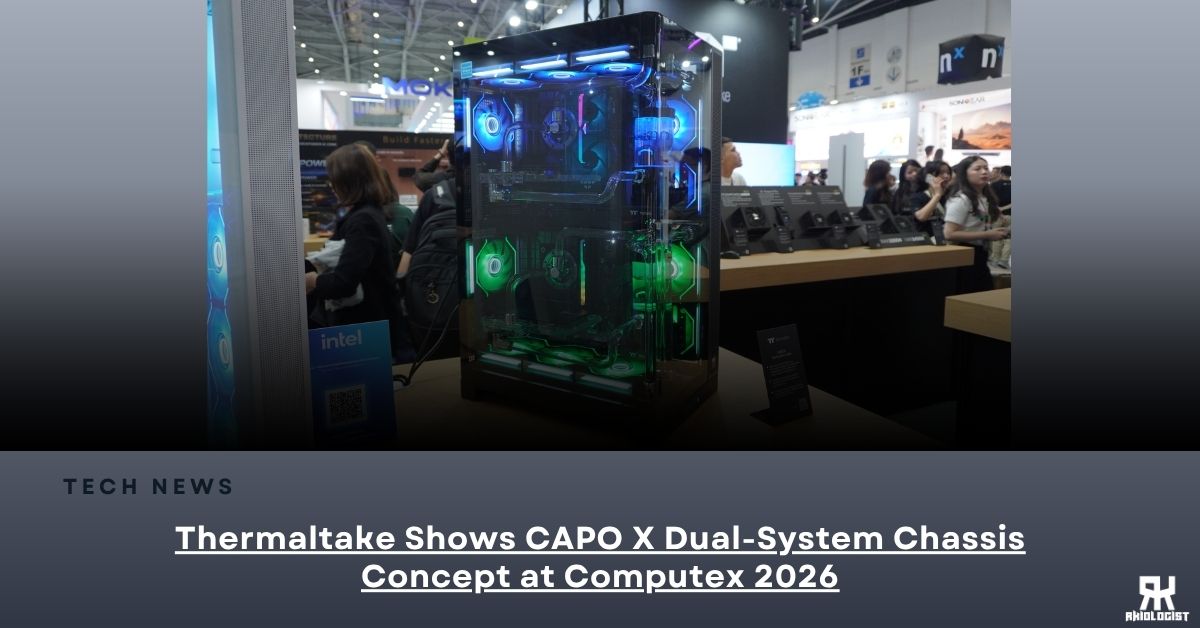
Walking through Computex 2026, it’s hard to miss the number of “AI-ready” systems being thrown around. Most of them blur together after a while. Thermaltake’s CAPO X didn’t.
Instead of chasing the usual single-system showcase build, Thermaltake went in a different direction. The CAPO X is built around a dual-system layout, housing two separate Micro-ATX setups inside one chassis. Not just squeezed in but actually designed to coexist as equal parts of the system.
From what was shown at the booth, the idea is pretty clear. This isn’t about redundancy or gimmicks. It’s aimed at workloads where splitting tasks makes sense. One system can be dedicated to AI compute, inference, or development, while the other handles everything else. Different roles, same enclosure.
What stood out more than the concept itself was the execution. The layout doesn’t treat the second system like an afterthought. Both builds are fully visible through a curved tempered glass panel that wraps around the front corner. You’re not just looking at one PC anymore; you’re looking at two systems presented as one unified setup.

Cooling also reflects that intent. Support for dual 360 mm radiators and up to thirteen 120 mm fans makes it clear this isn’t meant for lightweight configs. It’s built with high-power hardware in mind, the kind that actually needs that level of airflow.
Dual-system cases have always been around, but they’ve stayed niche for a reason. They’re usually oversized, complicated, and expensive to justify. The CAPO X feels like Thermaltake trying to revisit that idea with a more modern approach, something that fits today’s push toward AI workloads and workstation setups.
As it stands, the CAPO X is one of the more unusual things on the floor. Not because it’s flashy, but because it brings back a concept most people moved on from and makes a case for why it might still matter.



Leave a Reply